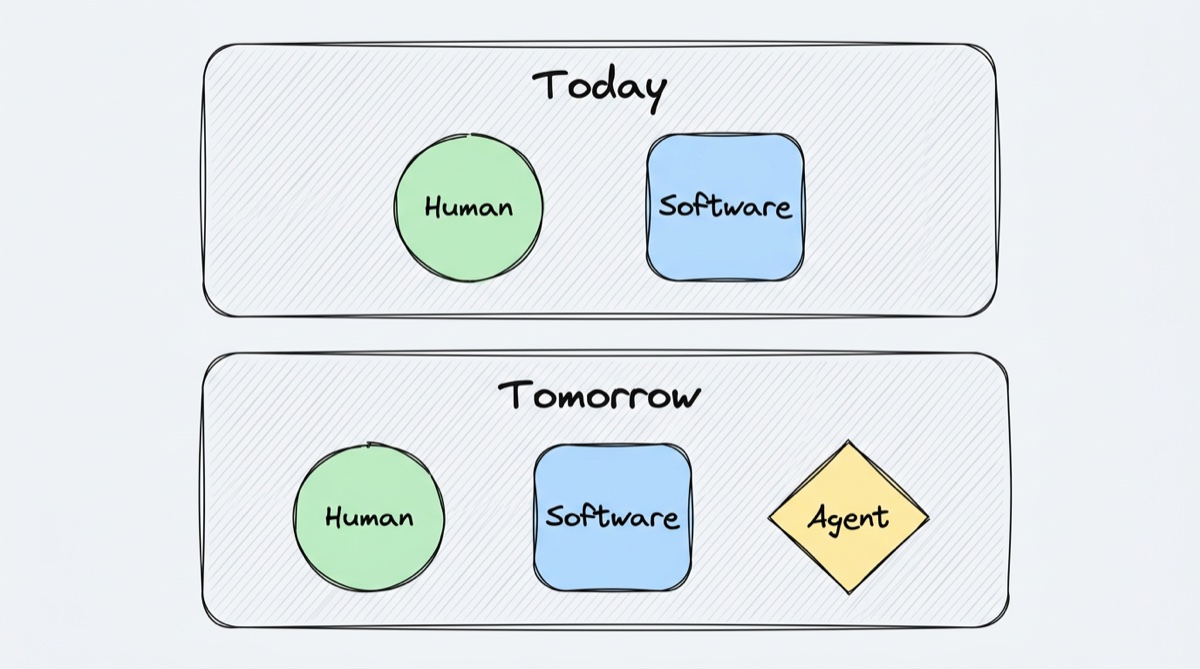
There are moments when the world shifts beneath our feet, though we rarely recognize them as they happen. Two thousand years ago, Roman jurists crafted something that would outlive their empire: the collegium. The idea that organizations could legally own property, enter contracts, and outlive its founders was strange but revolutionary. They created the first artificial persons and drew a blueprint for the modern corporation we know today.
We are witnessing the emergence of something equally profound with the rise of AI agents. These machine actors will transform not merely how firms operate, but what they fundamentally are.
AI agents are not just clever chatbots or automations with LLMs bolted on. They are entities that have memory, maintain state, pursue objectives, and work toward specific goals. An agent operates autonomously. It holds budget authority. It bears identity. It transacts. Fundamentally, we are shifting from binary systems (humans + deterministic software) to a ternary system, where agents participate as full economic actors.
To illustrate the profound change catalyzed by the introduction of AI agents, consider what happens when agents mediate general consumption. A person wishes to buy a shirt. Simple enough. They ask their agent. It knows their preferences, their budget, their secret vanities. In moments, the shirt is chosen, purchased, and delivered. For the buyer, this is a small magic. A delightful convenience that will quickly become ordinary.
But somewhere, an attentive merchant will watch in horror as their carefully crafted distribution advantages dissolve like salt in rain. No advertisement reached the buyer. No display caught their eye. No trusted voice “influenced” the purchase. The agent simply… chose. In that choosing, it rendered irrelevant the entire advertising apparatus that has dominated modern-day commerce.
This simple example illuminates the dislocation ahead. Traditional value chains flow linearly, from raw material to finished good, each step adding margin. Going forward, value will concentrate in a new layer of abstracted orchestration conducted by our non-human friends.
We've seen this before, of course. Platforms aggregate demand, steal the customer relationship, and reduce suppliers to commodities. But agents go much further. They don't just own the relationship; they are the relationship. They sit at the apex, curating and directing consumption itself. We are not improving our exciting economy, we are building its replacement. Organizations must adapt or face obsolescence.
So what are the strategic implications for organizations, markets, and investors?
For individual organizations, Conway's Law—which tells us that systems mirror the communication structures of their creators—becomes suddenly urgent. When Roman legions adopted signal fires, they became creatures of the night watch. When corporations embraced the telegraph, they grew nervous systems that spanned continents. Likewise, add agents to internal communication and you will ship agent-compatible systems. Add agents to decision processes and you will create agent-compatible strategies. Enduring organizations, either by conscious design or through evolutionary pressure, will inevitably reshape themselves around these non-human participants.
For markets, everything accelerates. For example, in many domains, the patient work of human-centric negotiation will vanish, particularly when speed means winning. New intermediaries will rise to serve this new order. Not just orchestration platforms, but reputation systems for artificial actors or courts to adjudicate agent disputes. Yes, they will have disputes.
For investors, the key question is one of value preservation. What endures when all veils are lifted? Where does sustainable differentiation reside when agents compress information asymmetries to zero? Where can companies build value in a world of extreme operational efficiency?
Some moats are likely to endure the oncoming storm. Companies with proprietary data that regenerates frequently will always be one step ahead of what general agents can model. Companies shielded by law and regulation will also benefit. After all, agents cannot yet share whiskey with senators or send their children to school with regulators’ sons. But organizations whose primary edge was operating at peak human efficiency? Those will fade like autumn leaves in this new, post-industrial ecology.
As builders and investors we must recognize an exhilarating truth. Opportunity lies not in defending old moats but building new ones. We're not automating the economy we have, we’re building an entirely different one. Those who grasp this distinction will, like the Roman jurists before, write the rules for generations yet unborn.
Originally published on LinkedIn.