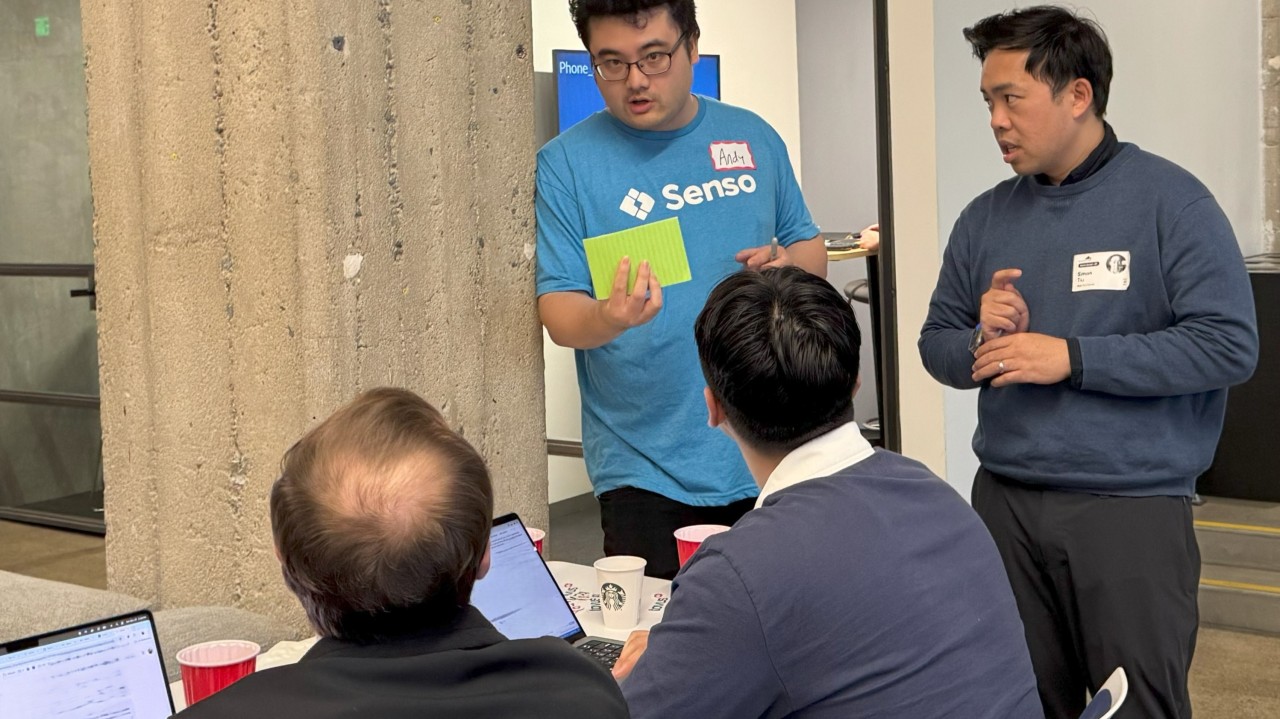
Senso’s Andy Tran (left) and Vertex’s Simon Tiu meeting with hackathon participants.
Last week, Vertex Ventures US and CreatorsCorner co-hosted a hackathon for enterprise AI agents. First, thanks to everyone who participated: 48 self-organized teams presented their multimodal AI agents to our panel of volunteer judges. The teams competed for over $50,000 worth of prizes from our generous sponsors, including Google, Windsurf, and Cloudflare (which graciously also made its headquarters available for the event).
A thing that happens in software is that someone builds a great product, then that product becomes very valuable, and then other people want to build the same product. This is not a new phenomenon. But what is new is how quickly those other people can now build the same product.
Last weekend I hosted a hackathon where small teams of developers set out to build enterprise AI solutions. The results were, frankly, alarming if you're in the business of selling enterprise SaaS. One team built a working clone of DocuSign. Another team replicated PagerDuty's core functionality. Each took under six hours, start to finish.
For those of us who've lived through multiple tech hype cycles—Web 2.0! Blockchain! Metaverse!—this feels genuinely different. Not in the "this will change everything" way VCs talk about every shiny framework. Different in the "this undermines fundamental assumptions about software economics" way.
Here's what I noticed as organizer and judge:
- AI coding assistants have gone mainstream. Our sponsor, Windsurf, demonstrated the latest developments in their AI coding agents and participating teams fully embraced it as their primary building tool. Without exception, every team leveraged AI coding assistants to construct massive portions of their code. Coding agents are here and will only get better.
- The multi-agent orchestra still needs a conductor. Teams struggled to orchestrate multiple AI agents. Watching developers troubleshoot agent authorization, state management and agent communication revealed many gaps in our current tooling. The next frontier isn't building individual agents—it's creating systems for seamless collaboration between them.
- SaaS leaders stand on surprisingly shaky ground. One team built a sales enablement tool rivaling ZoomInfo that enriched outbound messages using data from LinkedIn, YouTube, Instagram, and other platforms. Another recreated Zapier's core functionality in four hours, including an agent that wrote new integrations on demand. These weren't simple mockups, but working products that replicated capabilities requiring years of development and millions in funding previously.
- Voice interfaces are becoming primary. Several impressive projects focused on voice-based interaction, including an AI avatar to help onboard new SWE hires by explaining the code base through natural conversation and a customer service agent that could detect emotional cues in callers' voices. This evolution makes a lot of sense; after all, why translate thoughts into text when AI can understand speech directly.
We're witnessing the collapse of barriers between idea and implementation. Small teams can now build in days what previously took months. This doesn't just accelerate development—it fundamentally changes who can build what.
For established companies, your proprietary software may be easier to replicate than you think. For entrepreneurs, software creation is being democratized at unprecedented scale.
Last weekend left me both exhilarated and humbled. I'm already planning our next hackathon. If you're building in this space or want to sponsor future explorations, reach out. The wave is building—let's ride it together.
Originally published on LinkedIn.