How to make investors and your board love your usage-based revenue model
“Your revenue isn’t predictable enough.” If you run a usage-based startup, you’ve probably heard this concern from investors and board members. But many founders don’t realize: usage-based revenue can be more attractive to investors than traditional subscriptions if framed correctly.
Many valuable software companies are winning because of their usage-based models, not despite them. Investors are hunting for businesses that can grow efficiently and sustainably, sometimes forgetting that “recurring revenue (ARR)” is only a proxy for predictable revenue. When properly presented, your usage-based model can highlight the revenue predictability they’re looking for.
Once framed correctly, defensive answers about revenue predictability transform into offensive responses about growth potential and capital efficiency. Take Snowflake, which boldly declared “WE ARE NOT A SAAS MODEL” in its IPO roadshow, turning a potential liability into a cornerstone of their $70B+ IPO success.
As a former investment banker who has analyzed hundreds of revenue models, let me show you how to tell a powerful growth story that will engage investors and your board of directors to lean in rather than shy away.
The Strategic Advantage of Usage-Based Revenue
The SaaS landscape is evolving, and usage-based pricing is a crucial driver of growth. According to Tomasz Tunguz at Theory Ventures, companies with significant usage-based components demonstrated ~4x stronger net dollar retention (NDR) (1). OpenView’s 2023 SaaS Benchmarks report shows that companies with usage-based pricing are 50% more likely to be in the top quartile for growth rate and efficiency (2).
Most successful companies combine usage-based elements with a baseline subscription, but the usage component drives exceptional growth. Snowflake’s S-1 filing prominently highlighted its consumption-based model and reported NDR above 160%, largely driven by expanded usage from existing customers (3). According to OpenView’s 2023 State of Usage-Based Pricing report, companies with usage-based pricing grow faster and achieve higher valuations, especially with consistent usage patterns and strong customer retention (4).
Framing Your Revenue Mix
Changing the narrative around usage-based revenue starts with how you analyze and present your revenue streams. Most usage-based businesses have several revenue types that should be presented separately to investors. Here’s how to break down your revenue streams by their impact on valuation:
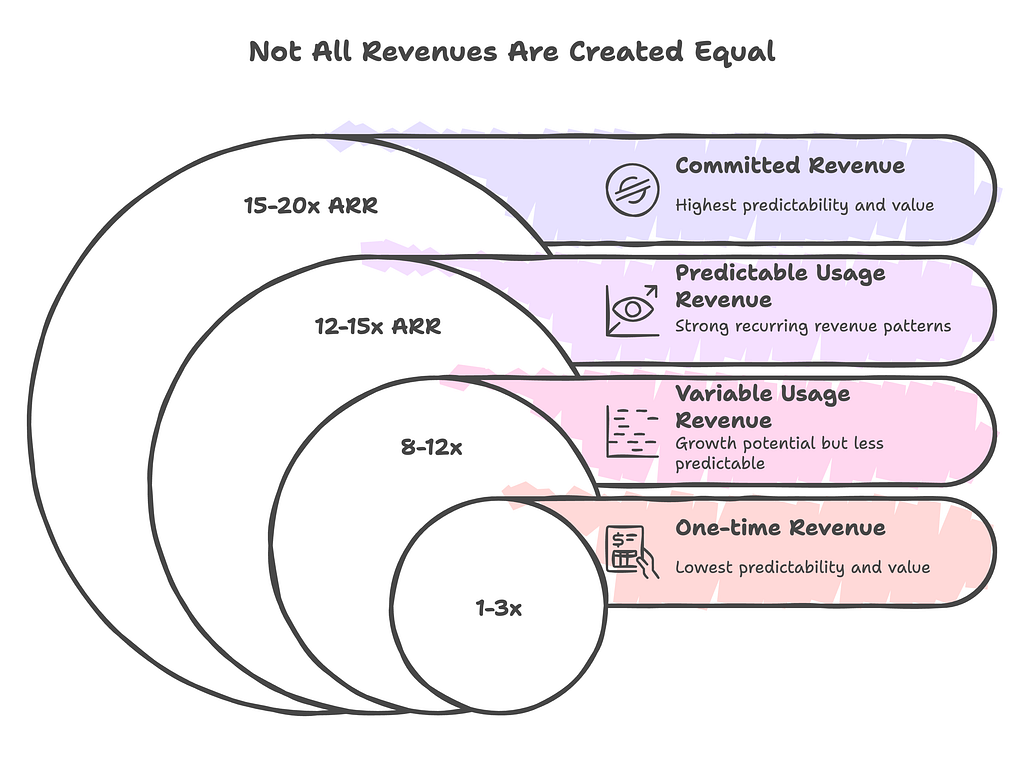
Note: These are illustrative valuation ranges only: in reality these can shift materially with market changes.
1. Committed Revenue (Highest Multiple: Often valued at 15–20x ARR)
- Fixed subscription fees (if any)
- Contractual minimum usage commitments
- Annual platform fees or baseline access charges
- Why investors love it: Highly predictable, contractually guaranteed, and typically renews automatically. This is your foundation.
2. Predictable Usage Revenue (Strong Multiple: 12–15x ARR)
- Consistent usage based on established customer behavior
- Regular consumption patterns (e.g., daily API calls, regular storage usage)
- Usage with strong historical reoccurrence (>90% month-over-month consistency)
- Why investors love it: This revenue shows product stickiness and natural growth. MongoDB’s success story centers on this category.
3. Variable Usage Revenue (Moderate Multiple: 8–12x ARR)
- Seasonal or project-based usage spikes
- Growth-driven usage expansion
- New customer onboarding usage
- Why investors value it: Represents growth potential and upside, but less predictable. Snowflake demonstrated how this category can drive exceptional NDR.
4. One-time Revenue (Lowest Multiple: 1–3x Revenue)
- Implementation fees
- Professional services
- Training or consulting services
- Why investors discount it: Non-recurring, often lower margin, and requires ongoing sales effort.
Pro tip: If appropriate, track and present the “graduation rates” between categories. How often does variable usage convert to predictable usage? How many customers move from minimum commitments to consistent overage? This progression tells a compelling story about your business’s maturity and growth potential.
Building the Growth Narrative
The best usage-based revenue stories focus on three key elements:
- Customer Success Alignment Show how increased usage directly reflects customer value and success. When usage grows month after month, it’s one of the strongest signals of product-market fit you can offer investors.
- Predictability Within Variability Demonstrate how usage patterns become predictable over time. Use cohort analyses to show how customer usage typically evolves and stabilizes, making your revenue more forecastable than it might appear.
- Unlimited Growth Potential Unlike traditional subscriptions, usage-based models have no built-in ceiling. Show how your most successful customers continuously expand their usage, proving the model’s potential for organic growth.
Metrics That Matter
To make your case effectively, focus on these key metrics:
- Net Dollar Retention (NDR): Highlight how usage-based pricing enables NDR rates above 120%, often surpassing traditional subscription models
- Usage Consistency: Show the percentage of customers maintaining or increasing usage month-over-month
- Cohort Behavior: Demonstrate how customer usage patterns mature and become more predictable over time
- Growth Efficiency: Calculate and showcase your revenue growth relative to customer acquisition costs
The Path Forward
You can transform investor skepticism into enthusiasm by focusing on usage metrics, cohort analyses, and customer behavior patterns. The key is to demonstrate that your revenue isn’t just predictable — it’s positioned for explosive growth because it’s tied to customer success.
If you’re in the early stages of building a usage-based company or working on innovative pricing models, I’d love to hear from you. Feel free to reach out on LinkedIn or Twitter @simontiu — let’s continue the conversation about turning your “uncertain” revenue story into an unstoppable growth narrative.
Sources:
(1) Theory Ventures (2024). “2024 Theory Ventures GTM Survey.”
(2) OpenView (2023). “2023 SaaS Benchmarks Report.”
(3) Snowflake (2020). Form S-1 Registration Statement.
(4) OpenView (2023). “State of Usage-Based Pricing Report.”
Originally published on Medium.